
A hymn by a man who once traded slaves — the story of “Amazing Grace”
Here is a hymn written by a man who once traded slaves. Korean churches sing it as Hymn No. 305, “나 같은 죄인 살리신”; in English it is “Amazing Grace.”
Our Hymn Story reel told this story in a few seconds; here it is in a little more detail. Dates and events come from Newton’s own writings and sources we could check, and where something is our inference, we say so.
March 1748, the North Atlantic
John Newton was an Englishman, born in 1725, who made his living at sea. In March 1748 his ship, the Greyhound, was caught in a violent storm in the North Atlantic. With the ship breaking up and about to go down, he cried out to God for mercy.
The ship did not sink. From then on he began to read the Bible in earnest. He tells this story himself in his autobiography, An Authentic Narrative, published in 1764.

Six more years on slave ships
But the story doesn’t end there. After the storm, he did not leave the slave trade. He served as mate on a slave ship, and from 1750 to 1754 he was captain of slave ships himself.
Looking back years later, he wrote that at the time he had no scruples about the trade. Nor did he leave the sea because his mind had changed: in 1754 a sudden seizure broke his health, and he could no longer sail.
Tide surveyor at Liverpool
In 1755 Newton became a tide surveyor in the port of Liverpool. He gave his spare hours to the Bible. Wanting to read it in the original, he taught himself Greek, then Hebrew and Syriac.
What drove him was the grace that had saved someone like him. He took to heart Galatians 1:23–24, where people glorify God on hearing that Paul, who once persecuted the church, now preaches the faith. In the fourteenth letter of his Narrative he wrote that he would rather be useful to others than die a celebrated linguist.
There were people along the way, too. At St Kitts in the Caribbean, a devout captain named Alexander Clunie helped him in the faith, and in Liverpool he followed George Whitefield’s preaching so closely that he was nicknamed “young Whitefield.”

A door that stayed shut, until 1764
Newton wanted to be ordained, but the way did not open easily. In 1758 the Archbishop of York refused him, and he had to wait several more years.
In 1764 he was finally ordained in the Church of England and became curate of the small village church at Olney.
New Year’s Day 1773, Olney
On January 1, 1773, the text of the New Year’s sermon at Olney was 1 Chronicles 17:16–17, where David asks, in effect, who he is that God has brought him this far. Matching the hymn against Newton’s sermon notes, it appears he wrote this poem to go with that sermon.
Its original title was “Faith’s Review and Expectation.” In its opening lines he calls himself a “wretch.” The poem was published in 1779 in Olney Hymns.

A wretch’s confession
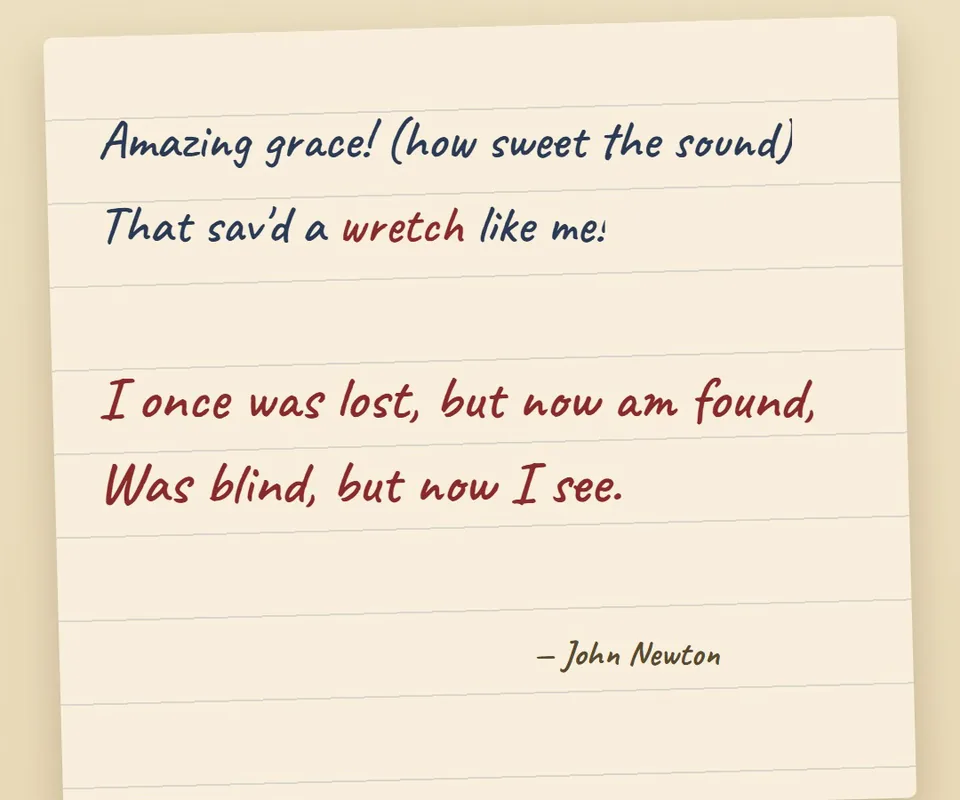
“Amazing grace! (how sweet the sound) / That sav’d a wretch like me!” This is how he sang of the grace that saved even a man who had bought and sold slaves. The lines that follow are still the best-loved confession of the hymn: “I once was lost, but now am found, / Was blind, but now I see.”
1788: “comes too late”
In 1788 Newton published a pamphlet, Thoughts upon the African Slave Trade, describing the horrors of the trade he had been part of, as he had seen and done them. He called it a public confession.
…a public confession, which, however sincere, comes too late to prevent, or repair, the misery and mischief to which I have, formerly, been accessary.1807, that winter
He also testified publicly for the abolition of the slave trade. His testimony and his pamphlet also influenced William Wilberforce, who led the campaign to abolish the slave trade.
On March 25, 1807, Parliament passed the Slave Trade Act. On December 21 of that year, Newton died. What was abolished then was the slave trade; slavery itself was not abolished in the British Empire until 1833.
The tune NEW BRITAIN, and Hymn No. 305
The tune we sing today is not one Newton chose. NEW BRITAIN is an early-19th-century American tune: it appears in the tunebook Columbian Harmony (1829) and was paired with these words in Southern Harmony (1835).
Korean churches know it as Hymn No. 305, “나 같은 죄인 살리신” (No. 405 in the older Unified Hymnal).

The hymn at a glance
- Title
- Amazing Grace (originally “Faith’s Review and Expectation”)
- Words
- John Newton · written for his New Year’s Day sermon, 1773
- Tune
- NEW BRITAIN · early-19th-century American (Columbian Harmony 1829, Southern Harmony 1835)
- First published
- Olney Hymns (1779)
- Korean hymnal
- New Hymnal No. 305 “나 같은 죄인 살리신” · Unified Hymnal No. 405
The original English text
Amazing grace! (how sweet the sound)That sav’d a wretch like me!I once was lost, but now am found,Was blind, but now I see.
’Twas grace that taught my heart to fear,And grace my fears reliev’d;How precious did that grace appear,The hour I first believ’d!
Thro’ many dangers, toils and snares,I have already come;’Tis grace has brought me safe thus far,And grace will lead me home.
The Lord has promis’d good to me,His word my hope secures;He will my shield and portion be,As long as life endures.
Yes, when this flesh and heart shall fail,And mortal life shall cease;I shall possess, within the vail,A life of joy and peace.
The earth shall soon dissolve like snow,The sun forbear to shine;But God, who call’d me here below,Will be for ever mine.
John Newton, Olney Hymns (1779) · public domain. These are the six stanzas as first printed, in the original spelling.
A closing thought
This is not a song written by a clean man. It is a poem by someone who had bought and sold slaves, who knew what he had been, and who called himself a wretch.
And he did not stop at that confession. Admitting it came too late, he told the world the horrors of the trade he had been part of.
Sources
- Hymnology Archive — Amazing Grace — The New Year’s Day 1773 sermon (1 Chr 17:16–17), original title, Olney Hymns text, tune NEW BRITAIN
- Library of Congress Blog — Rare Book of the Month: A Man Driven by Amazing Grace — Newton’s life and Olney Hymns
- Brycchan Carey — John Newton (1725–1807) — His years as mate and captain, Thoughts upon the African Slave Trade (1788)
- Wikipedia — John Newton — The Greyhound storm (1748), the 1754 seizure, Liverpool tide surveyor, refused 1758 and ordained 1764
- Wikipedia — Slave Trade Act 1807 — The Act of March 25, 1807
- Hymnary.org — Amazing grace! (how sweet the sound) — English text (cross-check), first publication
- Hymnary.org — NEW BRITAIN — Origin of the tune
- Anglican Compass — Hymn Guide: Amazing Grace — Background of the hymn
- hbible — 새찬송가 305장 — Korean title and number