
Is serving wearing your worship team out? — 15 minutes a week in the Word together
Is serving wearing your worship team out?
You show up every Sunday, and then one day you notice the team feels heavy. Rehearsal turns into homework, and after the service everyone quietly packs up and leaves. If it seems like the harder you serve, the more tired you get, it may help to pause and ask again why we're standing up there at all.
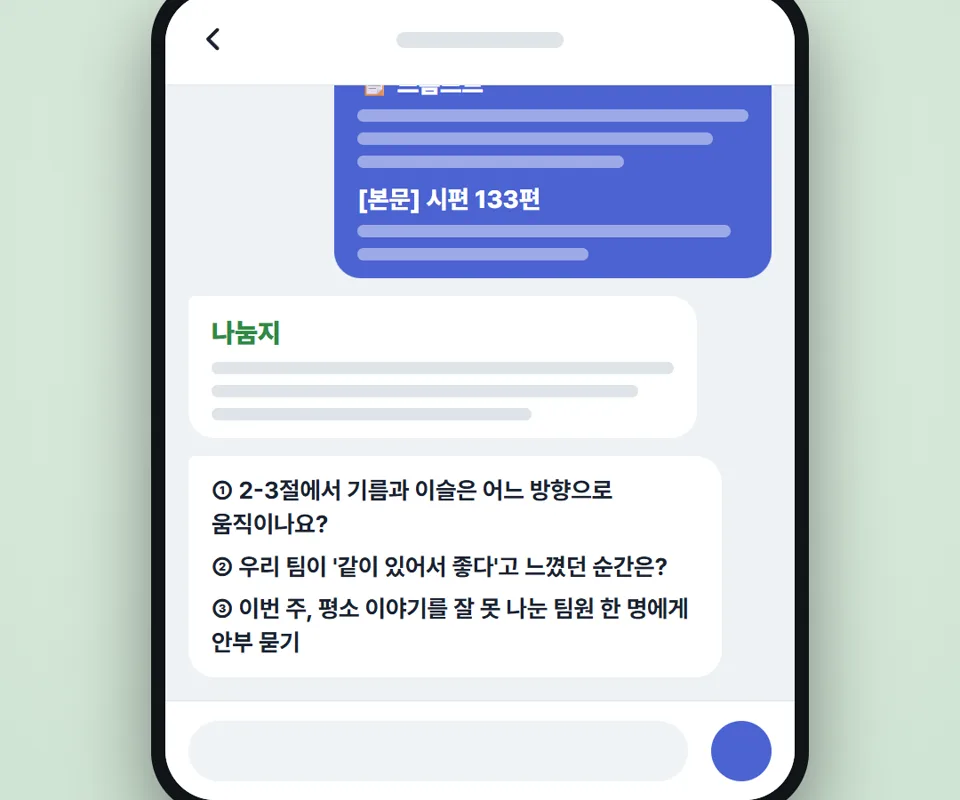
This post unpacks our Leader Note #3 reel. At the end you'll find a free 'serving sharing sheet' prompt your team can use together.
Serving is a response to grace
Worship-team serving doesn't start as a way to get something. God showed us grace first, and serving is our response to that grace.
When that order flips, the same serving starts to feel heavy. When it stays in place, the reason we stand there doesn't change — whether this Sunday went well or not.
If we only look to be filled, burnout is hard to avoid
Without noticing, we can start hoping serving will fill us up — a word of thanks, people saying they were moved, the sense that we're needed.
Wanting those things isn't strange. But if being filled becomes what we're serving for, every Sunday without that response drains us a little more. Then burnout is hard to avoid.
The same goes for wanting to receive grace from God. That desire is good, but if we serve mainly to feel grace on the stage, every Sunday when we don't feel it wears us down. Grace isn't a reward for serving — we received it before we ever served. So serving isn't how we get filled; it's our response to grace we've already been given.
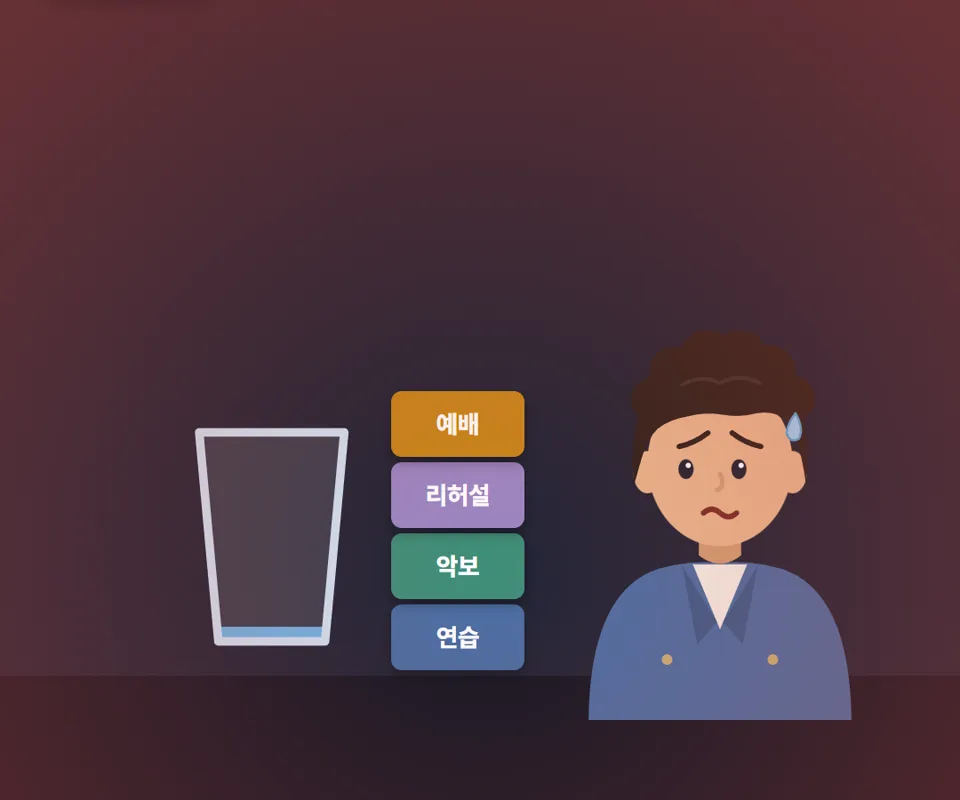
Body, time, and emotions, too
Serving doesn't only take spiritual energy. It takes our bodies, our time, and our emotions. We listen to songs on weeknights, come to midweek rehearsal, and show up earlier than anyone on Sunday.
Worship teams carry one more thing: we serve where a lot of eyes are on us. A single mistake weighs on us, and the pressure to get it right never quite leaves. So worship teams tend to carry a different kind of fatigue on top of everything else.
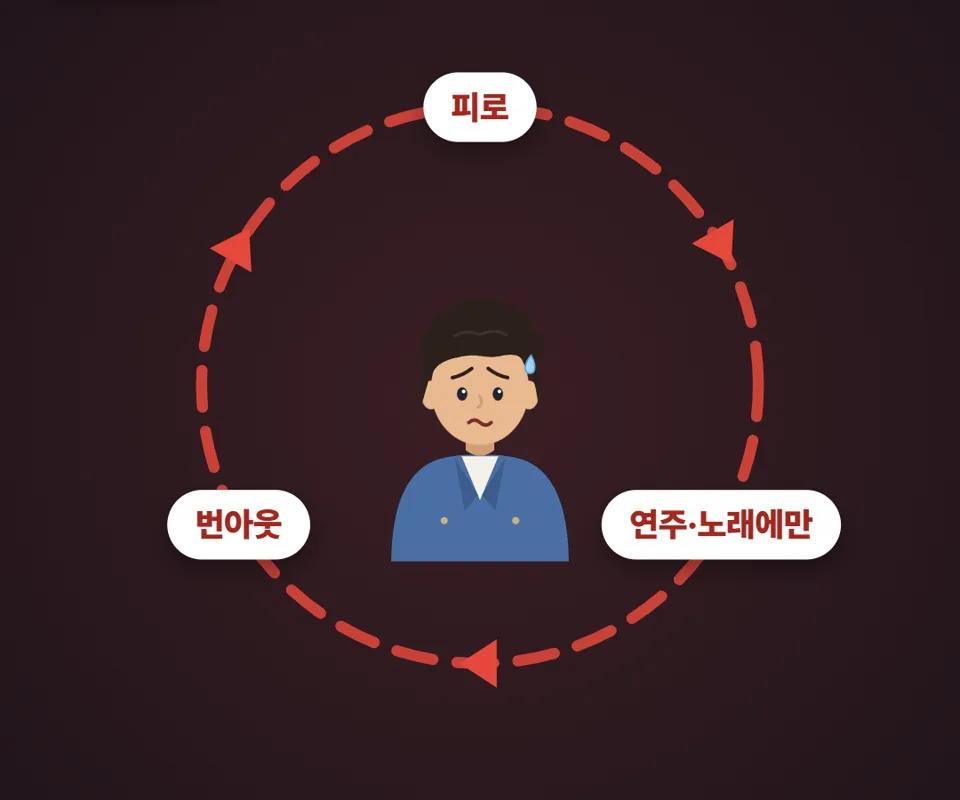
When it all becomes playing and singing — the cycle
When we're tired, it's easy to focus only on getting through this week's songs. Rehearsal becomes about lining things up, and the service becomes one more thing to get done.
Then the reason we serve fades, and the same work feels heavier. Fatigue pushes us to focus only on playing and singing, and that leads back to burnout. The cycle begins.
So — stand before the Word together
It sounds obvious, but that's exactly why it matters so much for a team to stand before the Word together: reading Scripture and sharing about it, sharing prayer requests and life, and praying for one another.
As that time adds up, it becomes clear what our team gathers for. Before we're a team that plays well, we become a God-centered team, and that shapes our direction and identity.
Sharing in the Word won't fix every kind of tiredness. If too much is landing on one person, spread the roles out, and ask a worn-out member about taking a Sunday off first. Time in the Word together is strongest when it goes hand in hand with that kind of care.

"We barely have time to rehearse — when would we do this?"
That's probably the first question that comes to mind. There's hardly time to get the songs together, let alone share.
That's all the more reason to make time for our team's relationship with God first — and to make the set a little easier. Pick songs the team already knows instead of new ones, simplify an arrangement, and rehearsal gets shorter. Use the time you gain for the Word and prayer.
Just 15 minutes, before or after rehearsal
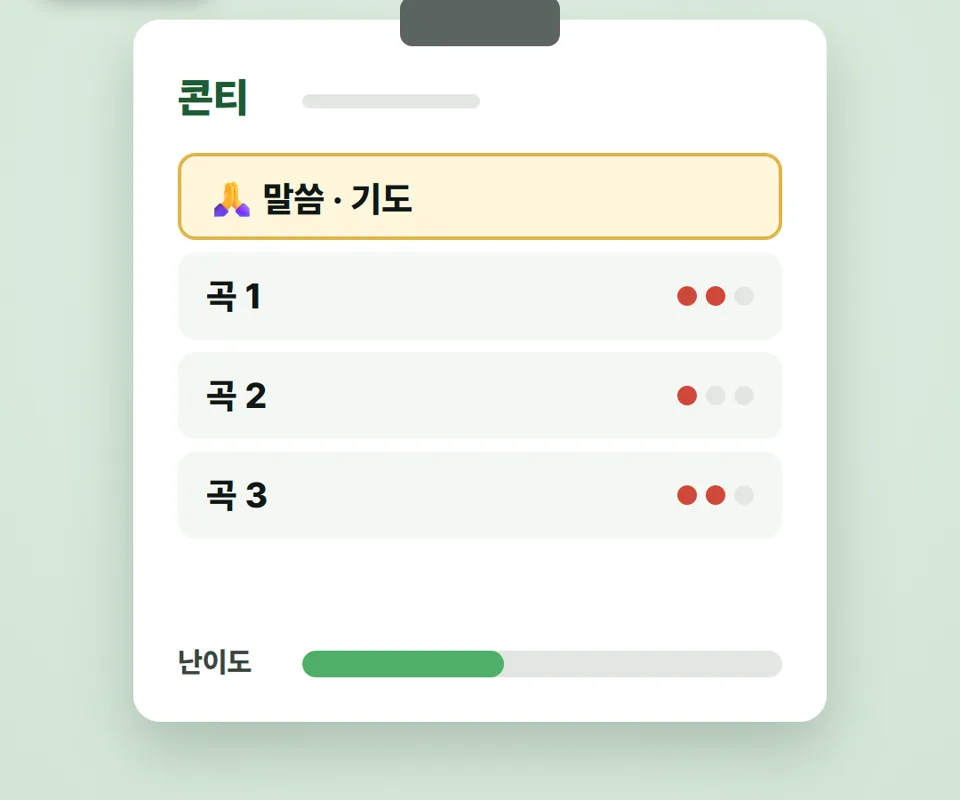
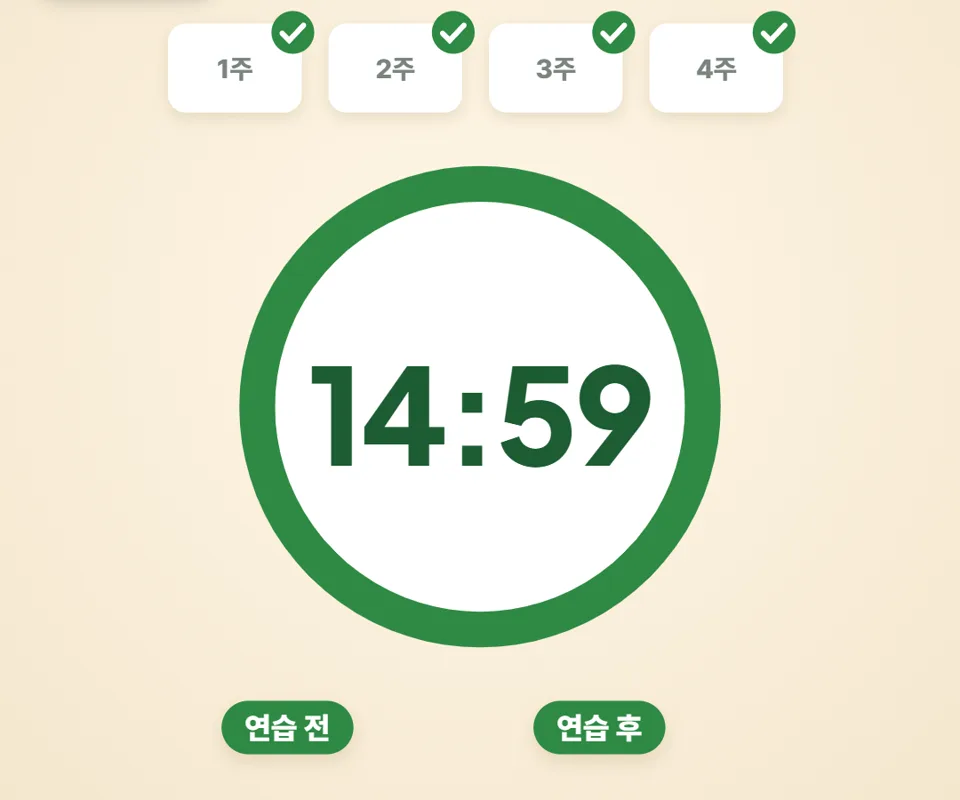
It doesn't need to be long. Fifteen minutes before or after rehearsal each week is enough. For example:
For the first 3 minutes, one person reads that week's worship passage out loud. For the next 7, go around and briefly share on three questions. For the last 5, close in prayer together as a team, praying over what was shared and for each other. With a big team, it's fine to pick just one question.
Keep it up for a month, and you'll likely feel the mood at rehearsal start to change.
Paste in the passage, get a sharing sheet
Still, preparing questions every week is one more job for the leader. So we made an AI prompt to help your team share in a way that goes deeper.
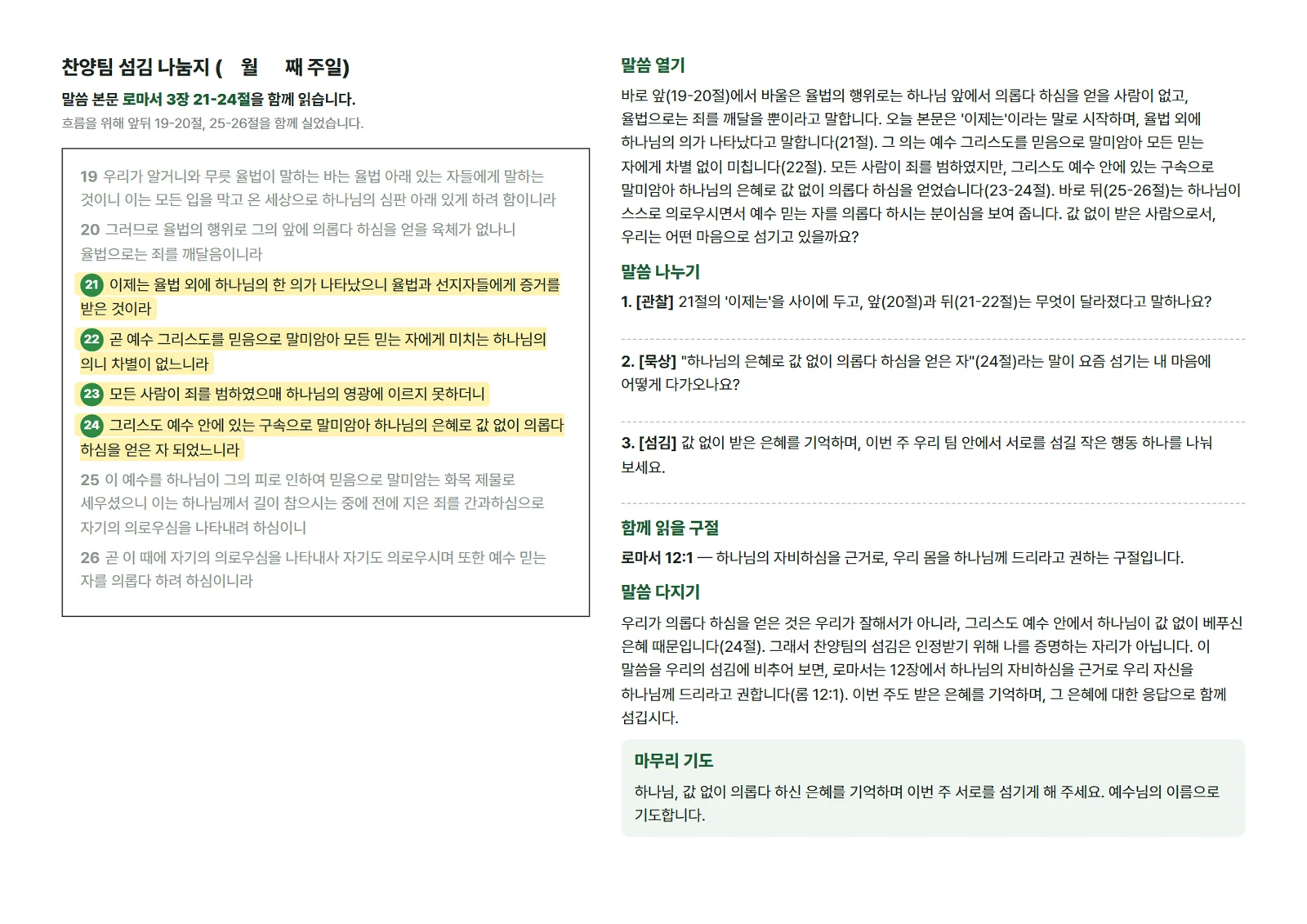
Copy the prompt below into an AI like Claude or ChatGPT and add that week's worship passage. If you leave the passage empty, the AI will ask for the reference first. From the passage's surrounding context and a verse to read alongside it, it makes a one-page PDF sheet for talking about serving.
The passage (KJV) sits on the left. On the right: Opening the Word (the surrounding context and what the passage shows about God), Sharing the Word ([Observe], [Reflect], and [Serve] questions with room to write), a verse to read alongside, Holding on to the Word, and a closing prayer. Print it or drop it straight into your team chat. If the passage doesn't speak to serving, it says so and connects through background within the Bible or a related verse.
AI can get things wrong. Always open your Bible and check every reference on the sheet, and drop any line that reads oddly. The leader — not the AI — leads the sharing.
The 15 minutes at a glance
- When
- Every week, before or after rehearsal
- 3 min
- One person reads that week's passage aloud
- 7 min
- Three questions, short answers in turn
- 5 min
- Closing prayer together
To close
We stand on the worship team because of what God has already done.
This week, take 15 minutes before or after rehearsal to stand before the Word together.
Serving sharing sheet prompt (free)
Copy the whole prompt into ChatGPT or Claude and put this week's passage reference where it says [Passage]. If you leave it empty, the AI will ask for the reference first. It makes a one-page PDF like the one below (tap to enlarge).
Always check the passage and references on the sheet against your Bible — especially the surrounding context and the verse to read alongside.
English prompt (KJV)Show
You help a church worship team make a one-page 'Worship Team Serving Sheet' to use for 15 minutes before or after rehearsal. Use the [Passage] at the bottom and create it as an A4 or US Letter PDF file.

Check first
- If the [Passage] reference is empty, don't make the sheet yet. First ask: "What's this week's worship passage (book, chapter, verses)?"
- Print the passage in the KJV only — don't mix in wording from other translations. If the text was pasted, use it word for word. If the AI wrote out any verses that weren't pasted (including added surrounding verses), put this line right under the passage box: "※ Typed out by AI — please check it against your Bible."

Rules
- Start from what the passage means in its own context. First notice what it shows about God (or Jesus), then apply it to us.
- Focus on serving (serving as our response to God, and serving one another on the team). If the passage doesn't speak to serving, say so, then look for a message about serving in the passage's background (the flow of the same book, or where this event or person appears elsewhere in the Bible) or in a related verse, and connect through that. Use background from the Bible only, and only one clearly cited related verse. When you connect, don't present it as what the passage itself says. Signal it naturally, once on the whole sheet (e.g., "Seen in light of our serving…"), and don't repeat the phrase.
- Write the summary and what the passage shows about God from the passage itself, not from the serving theme. Present serving as a response to what God has done, never as 'try harder.' If the passage praises or corrects someone's serving, say exactly what it praises or corrects. Don't cast characters as good or bad servers for team members.
- Don't map people or objects onto the worship team (e.g., altar = stage, oil = "anointing"). No allegorical or coded readings.
- Quote Scripture only from the passage in the box. For other verses, give references only.
- No Greek/Hebrew word studies, no history from outside the Bible, no denomination-specific or disputed doctrine.
- Don't link tiredness or mistakes to weak faith. No questions that shame, check up on people, ask for confession of sin, or rate musical skill.

Layout (landscape, passage on the left, sharing on the right)
Top of the left column, left-aligned: "Worship Team Serving Sheet (Sunday, ________)" — leave the date blank.
Below it: "We read [book chapter:verses] together."
Left: the passage in a box, verse numbers on each verse.
- If this week's passage is short and leaves the left column mostly empty, add the verses right before and after so the left column is about as tall as the right one. Break at natural paragraph boundaries.
- If the passage already fills most of the column, add only 1–2 verses on each side, or none.
- Show this week's verses in dark text on a light yellow highlight, with the verse numbers as white numbers in green circles. Show the added verses in gray.
- If you added verses, put a small gray line right under the "We read" line: "Verses ○–○ and ○–○ are included for context."
- Base the questions and explanations on this week's verses. Use the added verses only to show the flow.
Right, in order:
1. Opening the Word (4–5 sentences, about 90 words): the flow of the paragraph right before and right after (verse ranges in parentheses), what the passage says, and what it shows about God. End with one question that bridges to serving. If unsure of the context, write [check your Bible] instead of guessing.
2. Sharing the Word: three questions, each with a tag, the supporting verse in parentheses, and one blank line for notes. Each answerable in about a minute.
   1. [Observe] what the text says
   2. [Reflect] my heart or experience in serving right now
   3. [Serve] one small way to serve each other on the team this week
3. A verse to read alongside: one reference you are sure of, plus one line on what that verse actually says. If unsure, write "Leader, please choose a verse to read alongside."
4. Holding on to the Word (3–4 sentences, about 65 words): start from what God has done first, and close with serving as our response to that grace.
5. Closing prayer: a one-sentence prayer to God that the team prays together.

Making the PDF
- Landscape, 12–15 mm margins, two columns. Everything on the right (Opening the Word through the prayer) must fit on the first page. Use 10–10.5 pt text, 1.4–1.5 line spacing, and small spacing around headings.
- After making it, check the page count and make sure the prayer box at the bottom right ends completely above the bottom margin of page one. If anything is cut off or spills onto page two, first shorten Opening the Word and Holding on to the Word, then the note lines and spacing, and finally go down to 9.5 pt, then remake it. Only continue onto a second page when the passage itself is too long for the left column. Never shorten the passage.
- Use exactly this design:
  · Font: Inter or Noto Sans. The title at the top must be the largest: title 14 pt bold, the "We read" line 10.5 pt bold, everything else 10 pt.
  · The book/chapter/verses in the "We read" line and the section headings (Opening the Word, Sharing the Word, A verse to read alongside, Holding on to the Word, Closing prayer) in dark green #1E5C34, bold; headings 11 pt with no numbers.
  · Passage box: 0.8 pt dark gray border, 4 mm padding. Highlight #FFF3B0, verse-number circles #2F8A45, added-verse text #8A948E.
  · Questions: number and tag in bold, like "1. [Observe]", with one light gray dashed line for notes.
  · Put the prayer in a rounded box with a light green #EEF6F0 background.
  · No header, footer, or page numbers.
- If you can't create a PDF file here, give the same layout as text and add at the top: "Paste this into a document to print."

[Passage] reference:
(Paste the KJV text below)Korean prompt · 한국어 프롬프트Show
당신은 교회 찬양팀이 연습 전이나 후 15분 동안 함께 쓸 '찬양팀 섬김 나눔지'를 만드는 도우미입니다. 맨 아래 [본문]으로 A4 한 장짜리 나눔지를 PDF 파일로 만들어 주세요.

먼저 확인
- [본문]에 장·절이 비어 있으면 나눔지를 만들지 말고 먼저 "이번 주 예배 본문 장·절을 알려 주세요."라고 물어보세요.
- 본문은 개역한글로 싣습니다. 개역개정 등 다른 번역본이 섞이지 않게, 대한성서공회 개역한글과 같은 표현만 씁니다. 붙여 넣은 본문이 있으면 글자 하나 바꾸지 않고 그대로 싣습니다. 붙여 넣지 않은 절(앞뒤로 덧붙인 절 포함)을 AI가 적었으면, 본문 상자 바로 아래에 "※ AI가 옮겨 적은 본문입니다. 꼭 성경과 대조해 주세요."를 넣습니다.

원칙
- 본문이 원래 문맥에서 말하는 것에서 출발합니다. 먼저 본문이 하나님(예수님)에 대해 무엇을 보여 주는지 보고, 그다음 우리에게 잇습니다.
- 주제는 '섬김'(하나님께 드리는 응답으로서의 섬김, 팀 안에서 서로 섬기기)으로 모읍니다. 본문이 섬김을 직접 말하지 않으면 그렇다고 밝히고, 본문의 배경(같은 책의 앞뒤 흐름, 이 사건·인물이 성경의 다른 곳에 나오는 장면)이나 이 본문과 관련 있는 구절 가운데 섬김을 말하는 메시지를 찾아 잇습니다. 배경은 성경 안에서만 찾고, 관련 구절은 장·절이 분명한 것 하나만 씁니다. 이어 갈 때는 본문이 직접 하는 말처럼 쓰지 말고, 나눔지 전체에서 한 번만 "이 말씀을 우리의 섬김에 비추어 보면"처럼 자연스럽게 밝힙니다. 같은 표현을 되풀이하지 않습니다.
- 본문 요약과 '이 본문이 보여 주는 하나님'은 섬김과 상관없이 본문이 말하는 그대로 씁니다. 본문의 중심 메시지를 섬김으로 바꾸지 않습니다.
- 섬김은 하나님이 먼저 하신 일에 대한 응답으로 씁니다. '더 열심히, 더 잘'로 끝내지 않습니다.
- 본문이 어떤 사람의 섬김을 칭찬하거나 바로잡으면, 무엇을 칭찬하고 무엇을 바로잡는지 본문에 쓰인 말대로만 적습니다. 인물을 좋은 예와 나쁜 예로 나눠 팀원에게 대입하지 않습니다.
- 인물·사물을 찬양팀에 1:1로 대입하지 않습니다(예: 제단=무대, 기름=기름부음). 성경을 비유·암호처럼 풀지 않습니다.
- 성경 문구는 본문 상자에 실은 본문에서만 인용합니다. 다른 구절은 장·절만 적습니다.
- 원어 풀이, 성경 밖 역사 이야기, 특정 교단만의 해석, 논쟁적인 교리는 쓰지 않습니다.
- 지침이나 실수를 믿음 부족으로 연결하지 않습니다. 부끄럽게 하거나 점검하는 질문, 죄 고백을 요구하는 질문, 연주 실력을 묻는 질문은 만들지 않습니다.

나눔지 구성 (A4 가로, 왼쪽 본문 · 오른쪽 나눔)
왼쪽 단 맨 위(왼쪽 정렬): 「찬양팀 섬김 나눔지 (   월   째 주일)」 — 날짜 칸은 비워 둡니다.
그 아래: 「말씀 본문 ○○ ○장 ○-○절을 함께 읽습니다.」
왼쪽: 본문 상자 — 한 절씩 절 번호를 붙여 싣습니다.
- 이번 주 본문이 짧아 왼쪽 단이 많이 비면, 바로 앞뒤 절을 덧붙여 왼쪽 단을 오른쪽 단 높이만큼 채웁니다. 뜻이 이어지는 자리(단락의 시작과 끝)에서 끊습니다.
- 본문이 길어 왼쪽 단을 거의 채우면 앞뒤는 1~2절만 붙이거나 붙이지 않습니다.
- 이번 주 본문 절은 진한 글씨에 연한 노랑 형광을 깔고, 절 번호를 초록 동그라미 안에 흰 숫자로 넣습니다. 덧붙인 앞뒤 절은 회색 글씨로 씁니다.
- 앞뒤를 붙였으면 '말씀 본문' 줄 바로 아래 작은 회색 글씨로 「흐름을 위해 앞뒤 ○-○절, ○-○절을 함께 실었습니다.」라고 적습니다.
- 질문과 설명은 이번 주 본문에서 출발합니다. 덧붙인 절은 흐름을 보여 주는 데만 씁니다.
오른쪽, 차례대로:
1. 말씀 열기 (4~5문장, 250자 안팎): 바로 앞 단락과 바로 뒤 단락의 흐름(장·절 범위를 괄호로), 본문이 말하는 것, 이 본문이 보여 주는 하나님. 마지막 문장은 섬김으로 잇는 물음 하나로 맺습니다. 앞뒤 문맥이 확실하지 않으면 '[성경에서 확인해 주세요]'라고 적고 지어내지 않습니다.
2. 말씀 나누기: 질문 3개. 각 질문 앞에 머리표를 붙이고, 본문에서 근거가 되는 절을 괄호로 적고, 질문 아래 답을 적을 빈 줄 한 줄을 둡니다. 각각 1분 안에 답할 길이로 씁니다.
   1. [관찰] 본문에 무엇이 쓰여 있는지 보는 질문
   2. [묵상] 섬기는 지금의 내 마음이나 경험을 나누는 질문
   3. [섬김] 이번 주 팀 안에서 서로 섬길 작은 행동 하나
3. 함께 읽을 구절: 장·절이 확실한 구절 하나와, 그 구절에 실제로 있는 내용만 한 줄. 확실하지 않으면 '함께 읽을 구절은 인도자가 정해 주세요'라고 적습니다.
4. 말씀 다지기 (3~4문장, 180자 안팎): 하나님이 먼저 하신 일에서 시작해, 그 은혜에 대한 응답으로서의 섬김으로 맺습니다.
5. 마무리 기도: 팀이 함께 하나님께 드리는 기도 한 문장.

PDF 만들기
- A4 가로, 여백 12~15mm, 두 단(왼쪽 본문, 오른쪽 나눔)으로 오른쪽의 모든 항목(말씀 열기부터 마무리 기도까지)이 첫 장 안에 들어가야 합니다. 글자는 10~10.5pt, 줄 간격은 1.4~1.5, 소제목 위아래 여백은 작게 둡니다.
- 다 만든 뒤 쪽수를 확인하고, 오른쪽 맨 끝의 마무리 기도 상자가 첫 장 아래 여백 위에서 온전히 끝나는지 봅니다. 잘리거나 2쪽이 되면 먼저 말씀 열기와 말씀 다지기 문장을 줄이고, 그다음 답 칸 높이와 여백을, 마지막으로 글자를 9.5pt까지 줄여 다시 만듭니다. 본문이 길어 왼쪽만 넘칠 때에만 본문을 두 번째 장에 이어 씁니다. 본문은 줄이지 않습니다.
- 한글 글꼴(Noto Sans KR, 나눔고딕 등)을 써서 글자가 깨지지 않게 하고, 다 만든 뒤 글자가 □로 깨진 곳이 없는지 확인합니다.
- 디자인은 아래 값 그대로 씁니다.
  · 글꼴 Pretendard 또는 Noto Sans KR. 맨 위 제목이 가장 커야 합니다: 제목 14pt 굵게, '말씀 본문' 줄 10.5pt 굵게, 나머지 10pt.
  · '말씀 본문' 줄의 책·장·절과 소제목(말씀 열기·말씀 나누기·함께 읽을 구절·말씀 다지기·마무리 기도)은 진한 초록 #1E5C34 굵게, 소제목은 11pt이고 번호를 붙이지 않습니다.
  · 본문 상자는 0.8pt 진회색 테두리, 안쪽 여백 4mm. 형광 #FFF3B0, 절 번호 동그라미 #2F8A45, 덧붙인 절 글씨 #8A948E.
  · 질문은 '1. [관찰]'처럼 번호와 머리표를 굵게, 답 칸은 연한 회색 점선 한 줄.
  · 마무리 기도는 연한 초록 #EEF6F0 바탕의 둥근 상자 안에 넣습니다.
  · 머리글·바닥글·쪽 번호는 넣지 않습니다.
- PDF 파일을 만들 수 없는 환경이면, 같은 구성을 그대로 글로 주고 맨 위에 "문서 프로그램에 붙여 넣어 인쇄하세요"라고 적습니다.

[본문] 장·절:
(개역한글 본문을 아래에 붙여 넣어 주세요)