
What is a worship leader actually for? — History and responsibilities
The Bible never uses the words "worship leader." So what are we actually doing up front?
Role summary sheet — save or print it
The "what a worship leader does → why" sheet promised in the reel (in Korean). Look at it together before rehearsal or hand it to new team members.
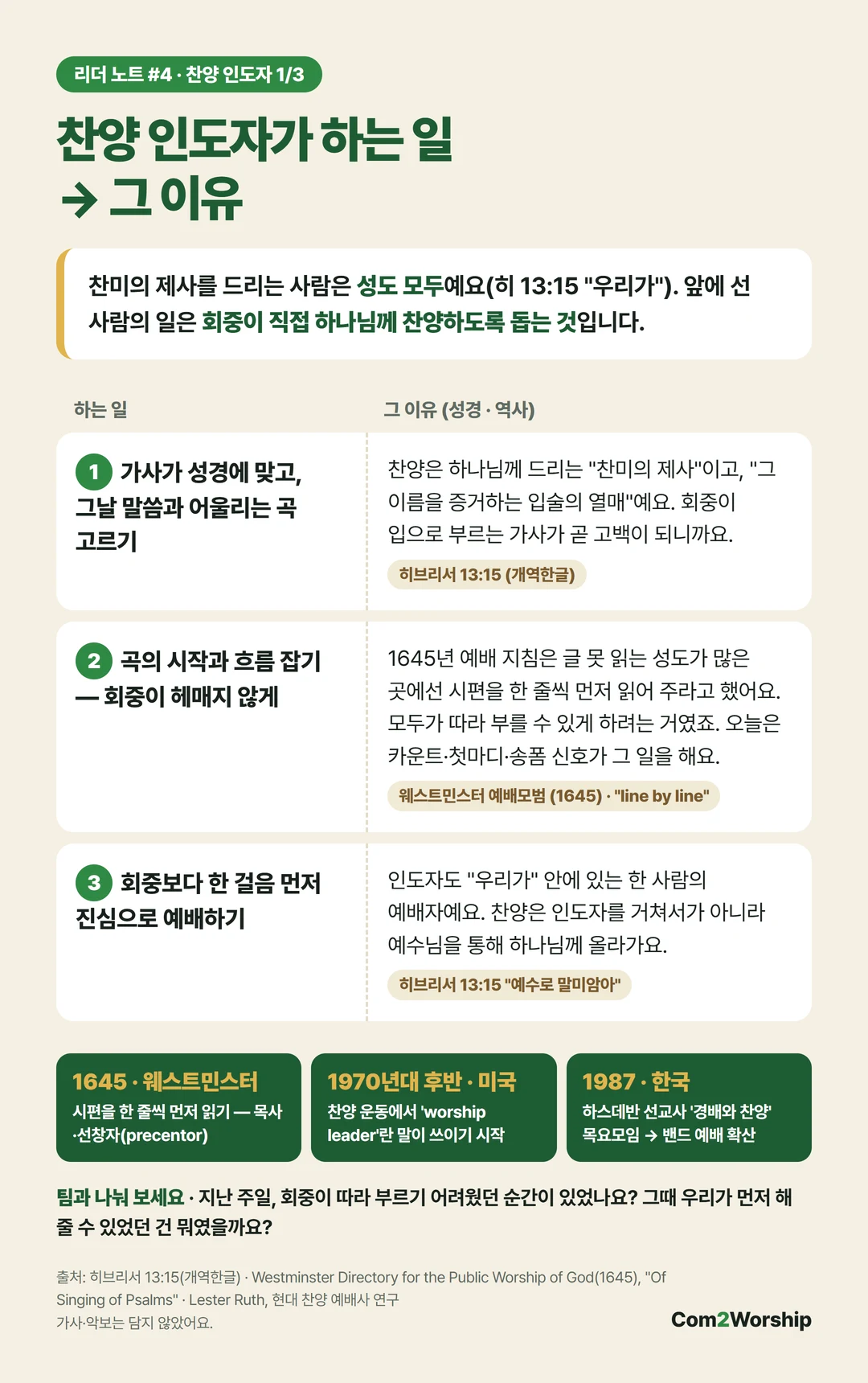
Search the Bible from cover to cover and you won't find the words "worship leader." Yet in most churches, someone picks up a mic every Sunday and stands in front of the congregation. This post first traces why that role exists in Scripture and church history, then turns the three responsibilities that follow into things you can try this week.
A word the Bible doesn't use — why that's not a problem
The New Testament letters name offices like overseer, elder, and deacon, but no office called "worship leader." That doesn't make the role unnecessary or unbiblical — Scripture simply doesn't name it.
So to understand what a worship leader does, we start with what the Bible says about worship songs: who sings them, to whom, and through whom. That answer defines the job of the person up front.
From the Old Testament to the New — who offers the sacrifice of praise?
When David brought the ark to Jerusalem, he told the chief of the Levites "to appoint their brethren to be the singers" (1 Chr 15:16), and that singing later continued with the temple sacrifices. The people weren't spectators: "all the people said, Amen, and praised the LORD" (1 Chr 16:36).
Still, the Levites can't be equated with worship leaders today. Their role passed down through families and, above all, belonged to the temple and its sacrifices. In the New Testament, that sacrifice is fulfilled: "But this man, after he had offered one sacrifice for sins for ever, sat down on the right hand of God" (Heb 10:12).
So Hebrews calls what we now offer "the sacrifice of praise." It isn't a sacrifice for sin but a thankful response to what Christ has done — and the very next verse, "But to do good and to communicate forget not: for with such sacrifices God is well pleased" (Heb 13:16), shows it reaches beyond the singing.
Notice "let us" and "by him." Peter says all believers are "an holy priesthood, to offer up spiritual sacrifices, acceptable to God by Jesus Christ" (1 Pet 2:5). The ones who offer praise are all of God's people, and the reason God accepts it is Jesus, not our musical skill.
By him therefore let us offer the sacrifice of praise to God continually, that is, the fruit of our lips giving thanks to his name.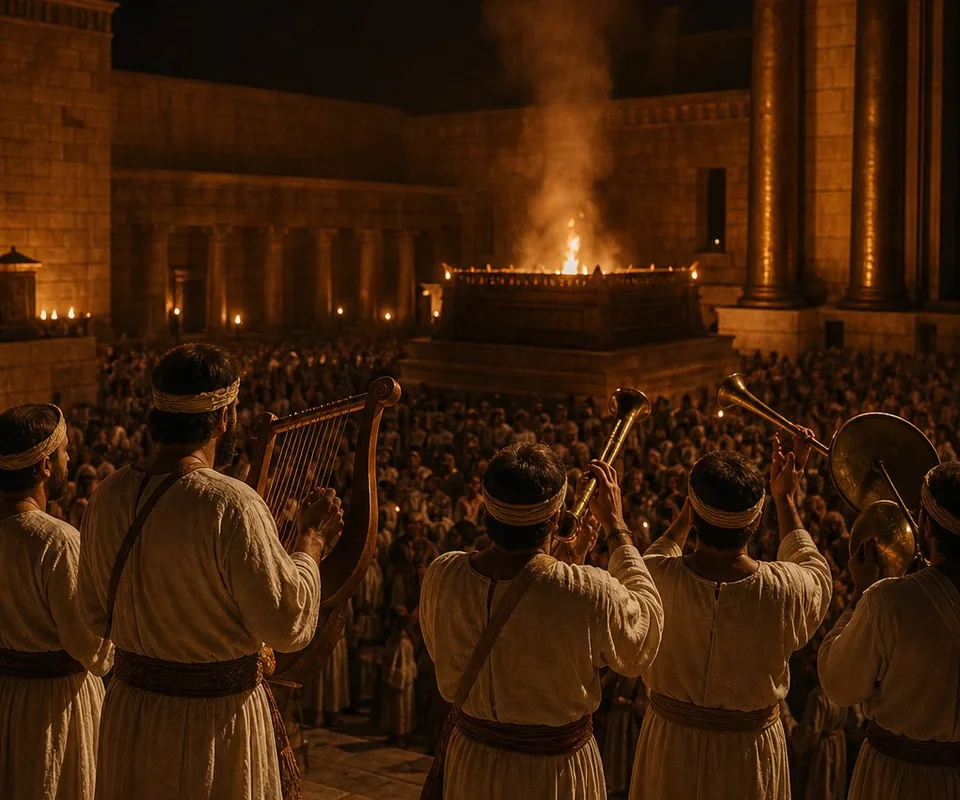
To one another, and to the Lord — songs we understand and sing together
Paul says the church's song faces two ways: "Speaking to yourselves in psalms and hymns and spiritual songs, singing and making melody in your heart to the Lord" (Eph 5:19). We sing to the Lord, and at the same time to the people beside us.
Colossians adds: "Let the word of Christ dwell in you richly in all wisdom; teaching and admonishing one another in psalms and hymns and spiritual songs, singing with grace in your hearts to the Lord" (Col 3:16). The words a congregation sings teach one another — which is why choosing those words is the leader's responsibility.
In 1 Corinthians 14, Paul says, "I will sing with the spirit, and I will sing with the understanding also" (14:15), and asks how someone who doesn't understand can "say Amen at thy giving of thanks" (14:16). Setting aside debates about spiritual gifts, the principle is clear: everyone should be able to understand and say Amen, "Let all things be done unto edifying" (14:26), and "Let all things be done decently and in order" (14:40).
From the lined-out psalm of 1645 to "worship leader"
Over the centuries, singing increasingly fell to clergy and choirs, and in Latin services the parts a congregation could understand and sing shrank. The Reformation gave back songs people could sing in their own language: the first Lutheran hymnal appeared in 1524, and the complete Genevan Psalter followed in 1562.
So did a singing congregation still need someone up front? The 1645 Westminster Directory answers. Drafted by the Westminster Assembly in London and adopted by the English Parliament and the Church of Scotland, it says everyone who can read should have a psalm book and others should learn to read — and that, for the present, where many can't read, the psalm should be read out line by line.
Who read the line matters: the minister, or a fit person appointed by him and the other ruling officers — in Scotland a precentor, in England a parish clerk. From the start, the person up front served in a role the church gave them, helping the congregation sing for themselves.
Later, through the Jesus Movement of the late 1960s and 1970s, bands leading congregational singing spread, and worship historian Lester Ruth explains that "worship leader" emerged as a technical term in the late 1970s and was mainstream by the mid-1980s. In Korea, band-led worship spread with the Praise & Worship Thursday gathering that missionary Stephen Hah began in 1987. The names and forms changed, but the purpose — helping the congregation praise God themselves — is the same as in 1645.
| When | What happened | The person up front |
|---|---|---|
| Old Testament | Levite singers appointed; the people answer Amen | A duty within temple sacrifice (not the same as today's leader) |
| New Testament | One sacrifice for sins (Heb 10:12); all believers offer praise (Heb 13:15) | No named office; the whole church sings to one another and to the Lord |
| 16th century | First Lutheran hymnal 1524; Genevan Psalter 1562 | Congregations sing in their own language |
| 1645 | Westminster Directory — read the psalm line by line | The minister or someone the church appointed (precentor, parish clerk) |
| Late 1970s | "Worship leader" comes into use in the US | A leader standing with a band |
| 1987 | Korea's Praise & Worship Thursday gathering begins | The leader's role grows with band-led worship |
But for the present, where many in the congregation cannot read, it is convenient that the minister, or some other fit person appointed by him and the other ruling officers, do read the psalm, line by line, before the singing thereof.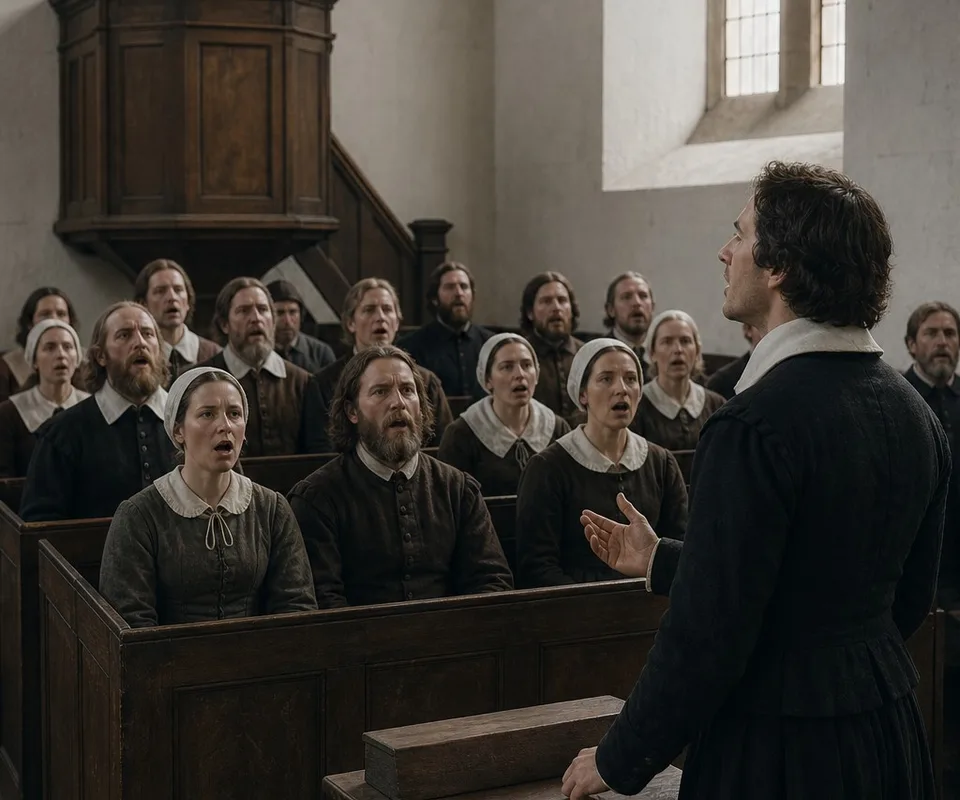
Responsibility 1 — choose songs true to Scripture that fit the day's Word
Praise is "the fruit of our lips giving thanks to his name" (Heb 13:15), so what the congregation sings becomes that day's confession — and, as Colossians 3:16 says, it teaches one another. So look at lyrics before melody, and check these five things as you plan the set.
- Does any lyric say something about God or the gospel that Scripture doesn't?
- If you pick one key word from the sermon passage, are there one or two songs that connect to it?
- Is the set more than a string of "I" songs — are there songs the church confesses together as "we"?
- Is the key comfortable for the congregation? Their range is roughly A3 to D5, so keep the highest note around C5–D5 and let E5 pass only briefly (common practice).
- Is there at most one new song this week, with a plan to sing it three or four weeks in a row?
Keys are easy to miss: original keys usually suit a soloist, so dropping a whole step or two is common (for example, B down to A or G). A key a male leader sings comfortably can leave women in the congregation holding a high E, so check each song's highest note first. In Com2Worship you can record each song's key, BPM, and meter, and see how often and how recently it was used — handy for counting new songs.
Responsibility 2 — set the start and flow so the congregation isn't lost
Just as the line was read out in 1645 so everyone could sing, today's leader knows where the congregation gets lost and opens the way ahead. Here are the usual moments.
| Moment | Why they get lost | Try this |
|---|---|---|
| First line after the intro | Not sure when to come in | Set the intro length (4–8 bars) as a team; in its last bar, the leader speaks the first lyric |
| New song | They don't know the melody | The team sings the first verse through once before everyone joins |
| Song-form changes | Chorus or next verse? | A hand cue the team agreed on, one bar before the next section |
| Highest notes | Too high, so they drop out | Lower the key so the top stays around C5–D5 |
| Slides | The next line appears late | Advance when the last word on the current slide is sung |
| Between songs | Long silence, or a sudden jump in key or tempo | Same key or a 4th/5th apart: go straight on; distant keys: play the next key's V chord for a bar or two |
| Ending | Is it over or once more? | Give a "once more" or "last time" cue before the final chorus |
This is where today's "lining out" comes in. Speaking every line gets in the way, so give the next lyric briefly only where people tend to get lost — the first line, form changes, a new song's bridge (advisor's view). There's no industry-standard hand signal, so agree on your own — fingers for verse numbers, a C shape for the chorus, and so on.
If the tempo jumps by more than 20 BPM between songs, a short keyboard pad before the next song helps (advisor's view). And when you modulate mid-song, a whole step up is typical and once per song is plenty; check that the top note still stays at or below D5 in the new key. Raise the key repeatedly and the congregation tends to drop out at the top rather than follow.
Responsibility 3 — worship sincerely with the congregation, and prepare during the week
The worship leader is one of the "us" in Hebrews 13:15. Preparing ahead is about order, not spiritual rank. Sincere singing doesn't appear suddenly on Sunday morning; someone who has prayed through a song's words during the week can sing them as their own confession. A common personal routine looks like this.
- Monday–Tuesday: read the sermon passage and this week's lyrics side by side for 10 minutes.
- During the week: listen to the songs on the way and pray one line of the lyrics.
- Sunday morning: after rehearsal, take two quiet minutes to pray before you take your place.
Missing this routine doesn't make a service fail — God receives our worship and gives grace. But preparation is our part, so plan rehearsal too. For a 60-minute midweek rehearsal, one way to split it (advisor's view, one example), assuming setup and tuning are done before the hour starts:
Ten minutes reading the passage together and sharing the song order and why. Thirty minutes on transitions rather than whole songs — the last eight bars of one song into the first eight of the next. Fifteen minutes learning the new song, and five minutes praying together. Rehearsing the seams saves time, and when the leader has the form and cues memorized, they can look up from the chart and see the congregation on Sunday.

You don't stand alone — with your pastor and your team
But the leader doesn't carry these three responsibilities alone. The pastor and elders are responsible for the direction and preaching of the whole service; the worship leader is entrusted with songs and flow within that. The person who read the line in 1645 was also appointed by the minister and ruling officers. Bob Kauflin's Worship Matters (2008), widely read by worship leaders, devotes a chapter to "Your Pastor" in its part on "Right Relationships."
So before you send the set to your team, try sending your pastor one line around Tuesday: "Pastor, since this week's passage is ___, I chose these songs. For a response after the sermon I'm thinking of ___ — does that work?" It's less asking permission than lining things up together. If the passage isn't set yet, just asking for it is enough. When you disagree, don't dig in on the spot; ask about the reasoning during the week, leave the decision with your pastor, and simply note your view for next time.
The same goes for your team. Add one line about why you chose the songs when you send the set, and your team plays knowing why — for example, "This week's passage is Psalm 23, so the last song ends with confessing the Lord as our shepherd."
Common misunderstandings and pitfalls
Even when you know the three responsibilities, a few Sundays in it's easy to drift. Here are three common misunderstandings and two pitfalls. First, seeing the worship leader as a performer up front. If ad-libs and long interludes are growing and the congregation only listens, pull the instruments back for one chorus and let their voices be heard. Even the voice that read the line in 1645 was there so people could sing along.
Second, seeing the worship leader as the one who creates the atmosphere. Preparing a smooth flow is good service, and music does move us, but grace in worship is given by God, not produced by the leader. So what a leader prepares first is the Word and lyrics the congregation will confess together.
Third, thinking the worship leader brings the congregation before God by their own power. "For there is one God, and one mediator between God and men, the man Christ Jesus" (1 Tim 2:5). Christ is "a minister of the sanctuary, and of the true tabernacle" (Heb 8:2), and the Westminster Confession (21.2) confesses that worship is offered only through Christ's mediation. To "lead" is to show the way, not to carry people to God.
And two pitfalls. One is reacting to a teammate's mistake on the spot with a look or gesture — the teammate shrinks, and the congregation sees your face too. Talk after the service, one thing, one-on-one, and start with your own part: "My cue into verse two was late — next time I'll give it a bar earlier." The other is serving for months without a Sunday off. Once a month, trade off leading with a teammate and worship from the pews. If your team is too small for anyone to step in, talk with your pastor about keeping that Sunday simple — fewer songs, ones the congregation knows well (Leader Note #3 also talks about Sundays off).
Talk it over as a team
Before or after rehearsal this week, pick one question to talk through. Focus on what was hard rather than who, and if the leader shares their own answer first, others find it easier to talk openly.
- Last Sunday, was there a moment when it was hard for the congregation to sing along? What could our team have done first?
- If you read this week's lyrics next to the sermon passage, where do they confess the same thing? (If you don't know the passage yet, use last week's songs and passage.)
- In your spot (vocals, instruments, sound, slides), what's one thing that helps the congregation sing — and one habit that tends to cover their singing (for example, ad-libs or volume)?
To close
The Bible doesn't use the title "worship leader," but in every era someone stood before the congregation, and there was always a reason. From the Levites' songs to the lined-out psalm of 1645 to today's worship band, that reason has been to help the congregation offer the sacrifice of praise to God themselves, through Jesus.
When you plan this week's set, read each song's lyrics once next to that day's Word.
Sources
- 대한성서공회 — 개역한글 성경 — Korean Revised Version text of the verses quoted in the Korean edition (English edition quotes the KJV)
- The Directory for the Public Worship of God (1645) — EPC Brisbane PDF — "Of Singing of Psalms" — "that the whole congregation may join herein", "for the present … line by line", "appointed by him and the other ruling officers"
- Wikipedia — Directory for Public Worship — Drafted by the Westminster divines; approved by the English Parliament (1644) and in Scotland (1645)
- Westminster Confession of Faith, ch. 21 — Orthodox Presbyterian Church — 21.2 — since the fall, worship is not offered without a Mediator, nor in the mediation of any other but of Christ alone
- Wikipedia — Lining out — The clerk or precentor who gave out each line; still practiced in Gaelic psalm singing on Lewis and elsewhere
- Wikipedia — First Lutheran hymnal (1524) — The first Lutheran hymnal, Nuremberg, 1524
- Wikipedia — Genevan Psalter — The 1539 Strasbourg psalter and the complete 1562 edition
- Andy Miller III — The History of Praise and Worship Music with Dr. Lester Ruth — Lester Ruth: "worship leader" arose as a technical term in the late 1970s and was mainstream by the mid-1980s
- Shin Yang, "Korean Preachers and Worship Leaders", Journal of Korean American Ministries & Theology 4 (2011) — Stephen Hah began the Praise & Worship (now All Nations) ministry with a Thursday gathering in 1987
- Bob Kauflin, Worship Matters (Crossway, 2008) — 목차(Open Library) — Part 4, "Right Relationships," includes a chapter titled "Your Pastor"